

David argues that modern warfare is accelerating so rapidly—driven by hypersonic weapons, dense sensor networks, and AI—that human decision-making is being squeezed out. He links this to rising global instability, information warfare against the West, and an approaching strategic confrontation centred on China, Taiwan, and the Indo-Pacific.
Faster weapons and compressed decision-making
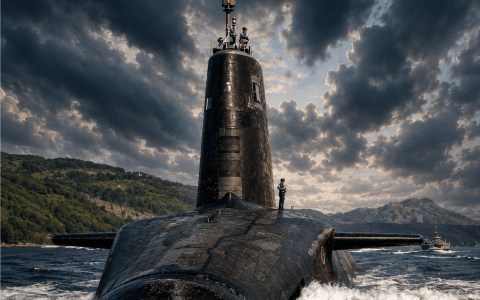
David explains that hypersonic missiles and real-time sensing compress the “kill chain”, forcing leaders to act with little time and incomplete information. This makes second-strike deterrence, particularly submarine-based nuclear forces, critical: even after a devastating first strike, a state can still choose how and when to respond calmly and deliberately.
He argues that classic arms-control treaties are increasingly ineffective because deterrence is no longer bilateral (US–Russia) but trilateral (US–Russia–China), making stability far harder to maintain.
AI, automation, and the risk of losing human control
A central warning is that AI already manages vast streams of military data and helps decide which weapons are used. As speed increases, keeping a human “in the loop” becomes impractical, pushing militaries toward fully automated lethal decision systems.
David frames this as an arms-race trap: states feel compelled to automate because their rivals will. Over time, this risks machines making existential decisions, echoing a real-world version of the “Skynet” scenario.
Cognitive warfare and political subversion
David argues that Russia and China are highly effective at cognitive warfare—using information operations to shape beliefs inside open Western societies. He claims this has weakened Western political cohesion, particularly by undermining support for defence spending and allied commitments.
He urges listeners to question where their views originate, suggesting that many political narratives are deliberately seeded to erode Western resolve from within.
China, maritime power, and why Taiwan is pivotal
David contrasts land powers (hierarchical, internally focused) with sea powers (trade-driven, outward-looking). He describes the US as a mature maritime power and China as a land power now rapidly transforming into a global naval force through massive shipbuilding and modern command systems.
On Taiwan, he stresses that it is not an isolated issue:
-
Any Chinese move on Taiwan pulls in Japan
-
Japanese involvement automatically brings in the United States
-
Therefore, a Taiwan conflict is a regional war from day one, not a limited local action
China’s strategy, he says, relies on anti-access/area denial (A2/AD): long-range missiles, drones, and space-based targeting to keep US forces out while overwhelming targets inside the exclusion zone.
Space, “Golden Dome,” and strategic compression
David describes a proposed US space-based defence system (“Golden Dome”) as offensive in effect, not just defensive. Because it would rely on low-Earth-orbit (LEO) constellations, it could project interception capability far beyond the US homeland and enable weaponised space (missiles and directed-energy systems).
He argues this accelerates strategic compression—pressuring rivals to act sooner before their advantages are neutralised—and drives escalation in anti-satellite warfare.
Key bullet points
-
Kill chain compression: hypersonics + sensors drastically shorten decision time
-
Second-strike deterrence: submarines preserve retaliation options after an attack
-
Arms control erosion: trilateral nuclear balance destabilises treaties
-
AI escalation risk: speed forces automation; humans get pushed out of control loops
-
Cognitive warfare: adversaries exploit Western openness to weaken resolve
-
China’s naval rise: shipbuilding enables transition to maritime hegemony
-
Taiwan as gateway: any conflict draws in Japan and the US immediately
-
A2/AD doctrine: missile and sensor “bubbles” deny access to adversaries
-
Space militarisation: LEO defence systems act as global power-projection tools
-
Economic outlook (David’s view): commodities trend higher; long-term bonds vulnerable; rising yields increase market stress












 © David Murrin 2026. All images courtesy of Getty Images. |