

Big picture claim
-
David argues we’re already in an early phase of a “slow-burn” World War III / hegemonic conflict: multi-theatre, resource-driven, and fought through proxies, economics, energy and technology as much as direct battles.
-
He says the escalation window is open now and runs to a peak around 2030, after which the wider struggle (China vs the West) could still continue for a decade.
His framework: cycles, empire decline, and “entropy”
-
He anchors his forecast in long-cycle history (he references a ~54–56 year Kondratiev-type cycle and a ~112-year “two-cycle” pattern that tends to end in hegemonic wars).
-
He layers on his “entropy” theory: societies need energy + coherent institutions to resist disorder; societies rise by producing “anti-entropy” (order, growth, functioning systems) and decline when they become chaotic, fractured, and corrosive.
-
He argues the West—especially the US and Europe—is in a late-stage decline dynamic: middle classes being squeezed, inequality rising, institutions polarising, and politics becoming more chaotic.
Energy as the real underpinning
-
A core theme is that power competition is fundamentally about energy (cheap, reliable supply = industrial capacity + resilience).
-
David claims China’s reliance on coal and its EV push are primarily strategic (energy security and industrial scale), not environmental.
-
He argues Europe’s net-zero path amounts to “industrial suicide,” making it structurally weaker versus China and even the US.
US politics and domestic unrest through that lens
-
Asked about protests and crackdowns in US cities, David places them in “stage five / last-chance” imperial decline.
-
He’s sharply critical of Trump personally and strategically:
-
Says Trump is entropic (chaos-fragmentation), corruption/enrichment-driven, and undermines alliances.
-
Uses “Jack Sparrow” as an analogy for leader-without-grand-strategy.
-
-
He argues the West’s only viable counter to China is scale via strong alliances (NATO + Indo-Pacific partners). He says current US actions do the opposite.
Russia/Ukraine: the “petri dish” argument
-
David calls Ukraine a live experimental battlefield where the “revolution in military affairs” is accelerating (drones, robotics, swarms, compressed kill chains).
-
His worry: China is learning faster from Russia’s battlefield experience than the US is learning from Ukraine.
-
He proposes two “fast end” options for the war:
-
A much tougher maritime squeeze on oil revenue via shadow-tanker enforcement/embargo logic.
-
A NATO “air umbrella / sky shield” over Ukraine (argues modern air power makes this feasible if ROE are set).
-
Middle East / Iran / Venezuela: regime-change logic and “peace bombs”
-
David interprets US pressure on Iran and Venezuela as part of a strategy to deny China a portion of its oil flows.
-
He criticises “forced peace” deals (his phrase “peace bombs”): he claims they freeze conflicts in ways that let adversaries rearm, making later violence worse (he uses Gaza and Ukraine as examples).
-
On Iran specifically, he argues:
-
The Iranian population is culturally distinct (Persian), educated, and has a strong secular undercurrent, but is repressed by theocratic rule.
-
Lasting Middle East stability is impossible while the current Iranian regime remains in power.
-
NATO and European defence spending
-
David agrees Europe has underinvested in defence.
-
But he rejects the idea that Trump is the main reason spending is rising: he says Russia/Ukraine is the driver, while Trump mainly adds uncertainty that serves Putin’s goal of fracturing NATO.
Military procurement / “battleship” debate
-
On the interviewer’s question about US military leadership and “lateral thinking,” David supports reform (procurement change can be good) but criticises humiliation-driven leadership.
-
He mocks the idea of big new battleships: argues modern warfare rewards dispersion and distributed lethality (many platforms + sensors) rather than concentrating assets vulnerable to hypersonics.
Closing takeaway
-
David’s bottom line: the West is entering a decisive, high-chaos period to 2030. China is the central long-term challenger, and the West’s best defence is allied cohesion + energy/industrial resilience + learning fast from modern war. He believes current Western (especially US) political dynamics are undermining that readiness rather than strengthening it.



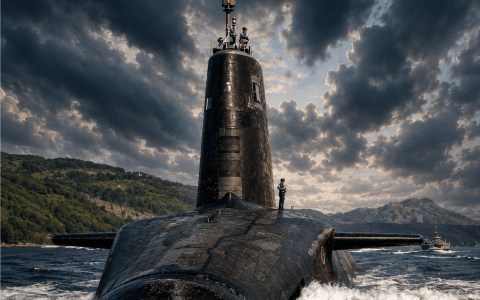









 © David Murrin 2026. All images courtesy of Getty Images. |