


In our The AI Revolution; Part 3, published over three years ago, we warned that-
The advantages of AI are obvious and include streamlining iterative processes, saving time and money, eliminating bias, and automating repetitive tasks. But like any technological revolution, there will be short-term consequences of massive unemployment in the high-tech nations, which will burden the social security systems. In effect, AI will quickly replace the iterative tasks in human societies. But is a long way from being able to replace the lateral and creative functions in society.
Thus, our long-term prediction is that, over the next generations, AI technology will change the ratio of lateral to linear people in a technological society, lateralising future human societies. Such a process could be very brutal, as it removes employment opportunities for linear thinkers, creating major social discord, lowering incomes, and ultimately forcing adaptations and lower breeding rates for the linear sector within society.
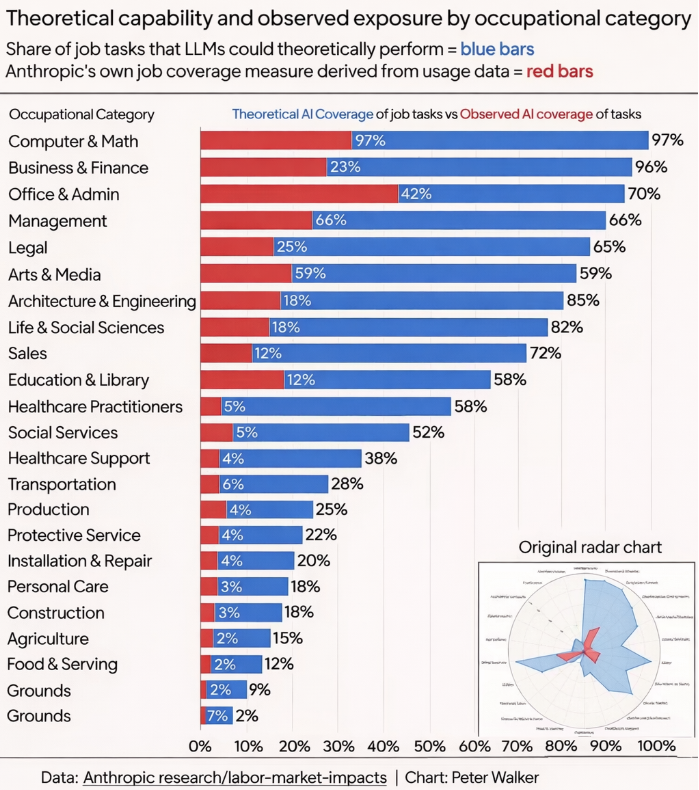
Today, Our Warning to the linear Thinkers is unfolding as affirmed by Antropic's March employment report and How AI Will Favour Lateral and Practical Thinking Over Linear Thinking (aka Neurodiversity)
In a recent interview, the CEO of Palantir Technologies offered a direct and provocative view of the future of work. He stated, “There are basically two ways to know you have a future. One, you have some vocational training. Or two, you’re neurodivergent.”
As AI systems continue to advance, many traditional white-collar tasks—such as coding, writing, and analytical work—are becoming increasingly automated. This shift is already changing which skills hold value in the labour market. Some roles are inherently more exposed than others, particularly those composed of structured, repeatable tasks. At present, AI adoption is clustering in areas such as:
- Computer and mathematical fields
- Business and finance
- Office and administrative work
- Legal, education, and parts of the media
These sectors rely heavily on language processing, logical structures, and predictable workflows—domains where AI performs well.
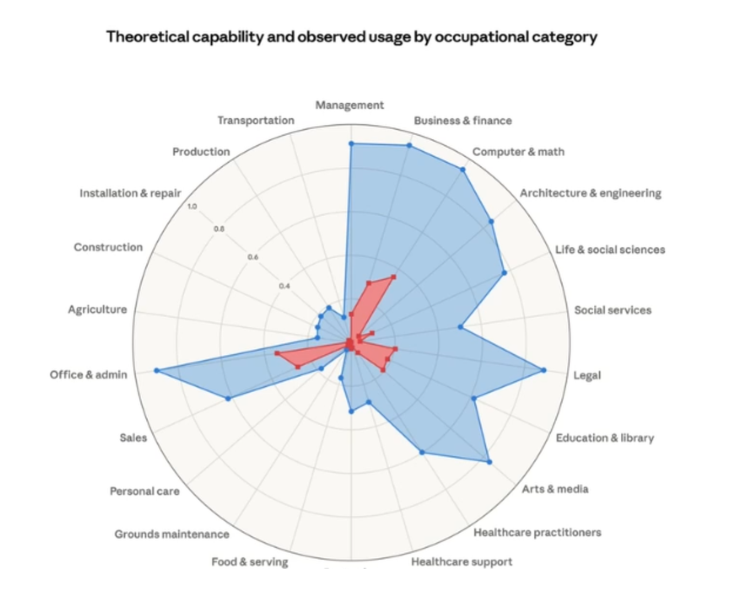
In contrast, the following areas remain significantly more resistant to automation:
- Construction
- Agriculture
- Installation and repair
- Transport
- Healthcare and personal care (hands-on roles)
These fields depend on physical presence, real-time judgment, and complex interaction with the physical world—capabilities that AI currently struggles to replicate.
In summary:
- Work that is predictable, digital, and repeatable is increasingly exposed to AI automation.
- Work that is physical, context-driven, and human-led will be in future ever more exposed to robotic advances
- Neurodiversity based on lateral thinking will become an ever more premium quality.
Looking ahead, organisations are likely to reassess how they evaluate talent. There will be a shift away from traditional credentials and toward practical skills, adaptability, and non-linear (lateral) thinking. This transition may elevate candidates with unconventional profiles and, as GF argues, could contribute to a broader shift in the social and economic paradigm.
This is just another example of how Global Forecaster keeps you ahead of The Heard!
So, can you afford not to know?
Subscribe Now To Murrinations Gold











 © David Murrin 2026. All images courtesy of Getty Images. |