

The New Quantum Fibonacci dynamics impacting Markets and Geopolitics
Summary
The Fibonacci sequence and the golden ratio recur across nature, architecture, markets, and now quantum physics, suggesting they are not merely aesthetic curiosities but expressions of deep structural optimisation principles in the fabric of our universe. From biological growth and galactic spirals to ancient monumental design, Fibonacci geometry reflects proportional expansion governed by iterative feedback and energetic efficiency. In financial markets, Elliott Wave theory applies similar fractal logic to crowd psychology, where impulse and corrective phases often unfold in Fibonacci-related proportions across both price and time.
Recent advances in quantum science — particularly research into quasiperiodic timing and time quasicrystals — suggest that Fibonacci-based structures may govern not only spatial geometry but also dynamical stability in time. Systems driven by ordered but non-repeating (quasiperiodic) patterns can suppress destructive resonance and maintain coherence under stress. This reframes Fibonacci geometry as a possible universal stabilisation principle operating across physical, informational, financial, and geopolitical systems.
Applied to markets and geopolitics, this implies that history does not repeat mechanically, but evolves through structured, non-identical waves shaped by proportional expansion, feedback, and phase transitions. Stability emerges not from rigid cycles, but from the ordered variability of those cycles. The deeper implication is that resilience across systems — from quantum computing to global governance — may depend on embracing adaptive, quasiperiodic structures rather than fixed repetition. We would call this framed adaptation - i.e., change and variability around a cyclical construct.
This new scientific reality reinforces the Global Forecaster's application of Elliott wave theory and our related five-stage model of empire, also known as the 5 Phase Life Cycle | David Murrin , which also incorporates quantum quasiperiodic principles.
Introduction
Fibonacci geometry appears repeatedly across natural systems, from the spiral phyllotaxis of sunflowers and pinecones to the logarithmic structure of hurricanes, galaxies, and nautilus shells, reflecting underlying growth dynamics governed by proportional expansion and self-similarity. The Fibonacci sequence — and its limiting ratio, the golden ratio (≈1.618) — emerges where systems evolve through iterative feedback processes, producing fractal structures that scale consistently across different magnitudes.
In financial markets, this same proportional geometry is explicitly embedded in Elliott Wave analysis outlined in Wave Pattern Analysis in Markets | David Murrin , which interprets price movements as fractal waves of crowd psychology unfolding in recurring five-wave impulses and three-wave corrections. Practitioners observe that retracement levels to teh previous completed wave generally conform to the Fibonacci harmonics of (38.2%, 50%, 61.8%) and wave extension targets to (161.8%, 261.8%), all of which frequently align with Fibonacci ratios, suggesting that market behaviour, like natural growth systems, reflects patterned human decision cycles rather than random actsion and motions. The persistence of Fibonacci proportions in both organic structures and market wave theory underscores that complex adaptive systems — biological or financial — share common mathematical architectures driven by iterative expansion and contraction.
For the ancient world, Fibonacci relationships were treated as divine relationships and over teh past two centuries were described as descriptive observations — patterns that appeared consistently but lacked a unifying explanatory framework. Only recently, with advances in complexity theory, nonlinear dynamics and quantum science, have deeper mechanisms begun to be explored and discovered.
At the quantum level, systems evolve through probabilistic wave functions and energy minimisation pathways that often favour optimised growth configurations. Some researchers suggest that the golden ratio may emerge naturally in systems seeking maximum efficiency in energy distribution, phase coherence, or resonance stability. While this remains an area of active investigation rather than settled doctrine, modern physics increasingly points toward a universe governed by underlying mathematical symmetries and scaling laws. What was once viewed as a mystical coincidence may instead reflect fundamental optimisation principles embedded within both physical reality and complex adaptive systems such as markets. Representing the very laws of Physics that comprise the fabric of our universe.
1.0 The Golden Ratio
The golden ratio is a mathematical proportion, approximately 1.618, that arises when a line is divided into two parts such that the whole length divided by the longer part equals the longer part divided by the shorter. This ratio, often denoted by the Greek letter phi (φ), appears repeatedly in geometry, nature, art, and architecture. It governs patterns of proportional growth, such as spirals in shells and galaxies, leaf arrangements in plants, and certain aesthetic compositions. The golden ratio also emerges from the Fibonacci sequence, where successive numbers converge toward 1.618 as they increase. Its recurring presence suggests it reflects an efficient and naturally stable proportional relationship found across many complex systems.
2.0 The Golden Ratio is honoured in ancient Architecture
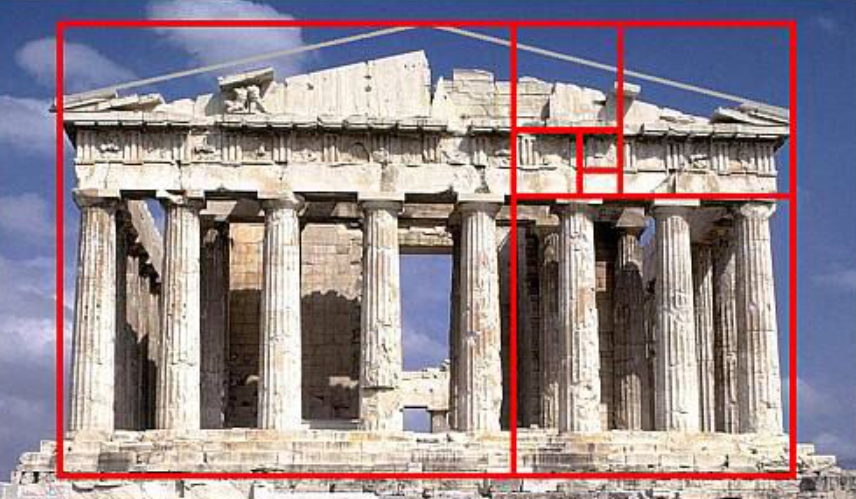
The golden ratio has been identified in ancient architecture across multiple civilisations, suggesting that long before it was formally defined mathematically, builders recognised and applied its proportional harmony intuitively. In ancient Egypt, many scholars argue that the proportions of the Great Pyramid of Giza approximate the golden ratio in the relationship between its height and base perimeter. In classical Greece, structures such as the Parthenon are often cited as incorporating golden ratio proportions within their façade dimensions and column spacing, contributing to their enduring aesthetic balance. Greek mathematicians later formalised the concept as the “extreme and mean ratio,” embedding it into geometric theory. Beyond the Mediterranean, proportional systems resembling the golden ratio appear in Roman architecture, Islamic geometric design, and later Renaissance works, where artists and architects consciously applied phi to achieve visual equilibrium. While debate continues over whether early builders explicitly calculated the ratio or arrived at it through practical proportional systems, the recurring presence of near-golden proportions across ancient monumental architecture suggests a deep historical intuition that certain geometric relationships produce structural stability and aesthetic coherence.
3.0 The Golden Spiral is a function of time and space
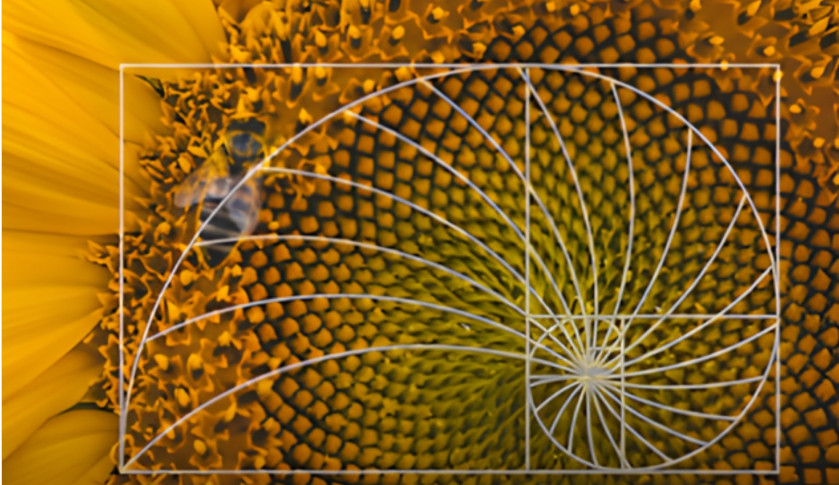
The golden spiral is a logarithmic spiral whose growth factor is derived from the golden ratio (approximately 1.618), meaning that with each quarter turn its radius expands proportionally rather than linearly. Mathematically, it emerges when a spiral’s expansion is governed by constant proportional growth, producing self-similarity across scale. This structure appears throughout nature not because of aesthetic preference but because it reflects efficient spatial and temporal growth processes. It can be observed in nautilus shells, sunflower seed arrangements, pinecones, hurricanes, and even spiral galaxies, where expansion unfolds incrementally while preserving overall form. In biological systems, the pattern often arises from phyllotaxis—optimized packing that maximizes exposure to light or space—while in physical systems it reflects rotational dynamics under consistent scaling laws. As a function of time and space, the golden spiral models how systems evolve: growth occurs outward through time while maintaining geometric coherence in space. It therefore represents a unifying principle in which proportional expansion links structure, motion, and development across vastly different scales of reality.
4.0 The Organisational Power of The Golden Ratio
The power of the golden ratio’s manifestation in nature lies in its role as an efficiency-optimising growth principle embedded across biological, physical, and even cosmic systems. In plants, Fibonacci spirals maximise sunlight exposure and seed packing efficiency — seen in sunflowers, pinecones, and succulents — enabling optimal resource distribution with minimal wasted space. In animal morphology, proportional relationships near the golden ratio often occur in body segmentation and growth scaling, reflecting stable developmental patterns. Spiral structures in hurricanes and galaxies approximate logarithmic spirals governed by the same underlying mathematical form, suggesting that dynamic systems evolving under rotational forces and energy conservation naturally converge toward this geometry. Even at the level of wave interference and resonance patterns, self-similar fractal structures echo Fibonacci scaling relationships. The recurring presence of this proportion across scales — from microscopic growth to galactic rotation — indicates not aesthetic coincidence, but a manifestation of systems organising toward structural stability, energetic efficiency, and scalable coherence under iterative feedback dynamics.
5.0 Fibonacci Proportions and Elliott Wave in Markets
Elliott Wave analysis is intrinsic to Global Forecaster’s market framework because it provides a structured model for interpreting crowd psychology as it unfolds through time. Rather than viewing markets as random or purely fundamentals-driven, Elliott Wave theory treats price movement as a fractal expression of collective human behaviour, progressing through impulse and corrective phases that repeat across degrees of trend. This allows long-cycle positioning—identifying secular bull and bear markets—while also framing shorter-term volatility within a coherent structural framework. From a geopolitical perspective, Global Forecaster integrates wave structure with macroeconomic stressors, including inflation shocks, debt cycles, hegemonic competition, and energy transitions. Major geopolitical inflexion points often align with wave terminations or accelerations, as shifts in power, conflict, or policy act as catalysts that release or redirect accumulated social mood. In this framework, Elliott Waves are not merely technical patterns but a diagnostic tool linking financial markets, economic cycles, and geopolitical evolution within a unified behavioural architecture.
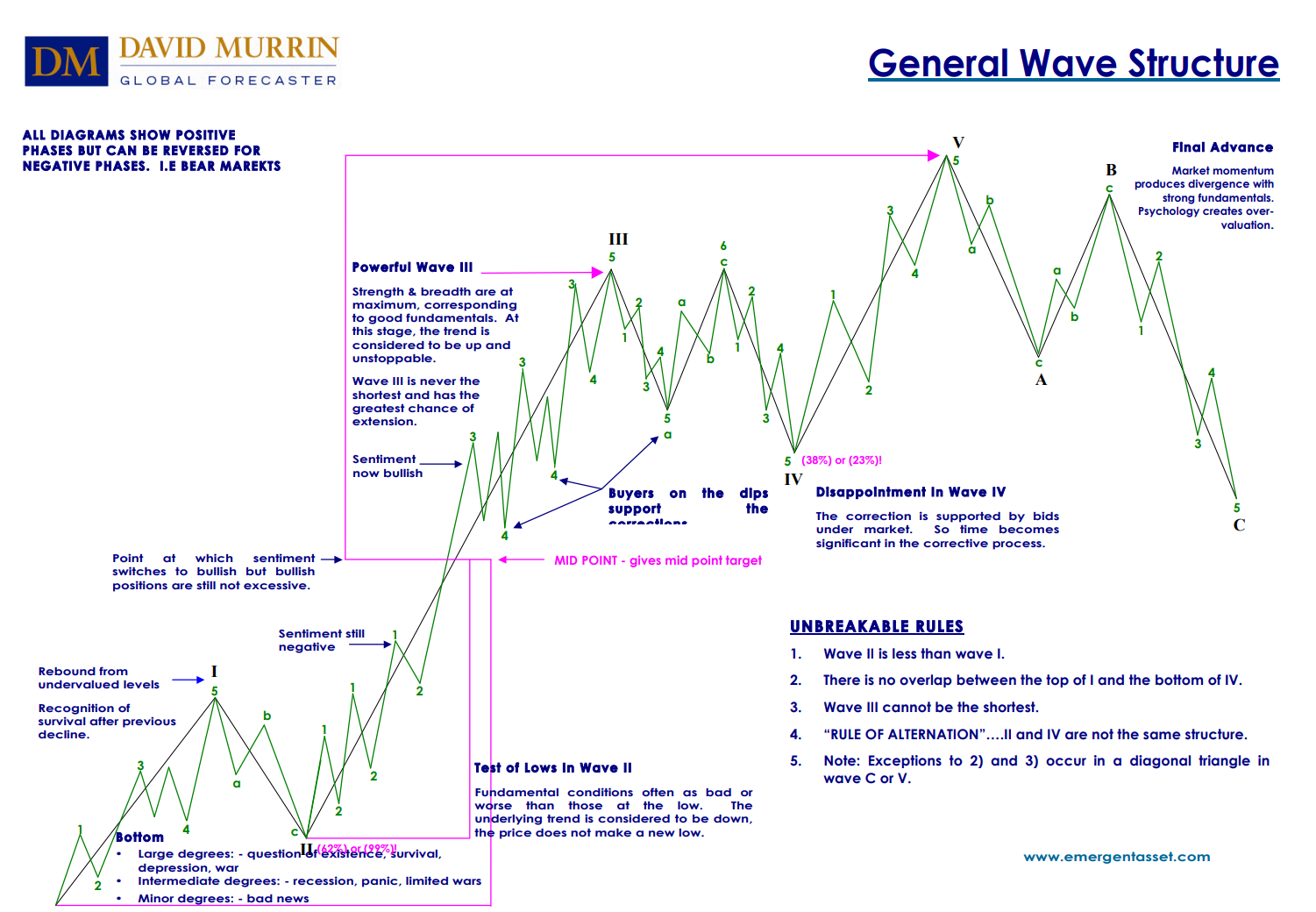
The relationship between Fibonacci proportions and Elliott Wave structures can be viewed through the lens of natural harmonics that emerge after an economic shock, such as an inflation surge. When inflation disrupts equilibrium in financial systems, markets rarely adjust in a straight line; instead, they oscillate as participants react, overreact, and then recalibrate expectations. Elliott Wave theory models this behaviour as impulse and corrective waves that unfold in fractal sequences, with retracements and extensions frequently aligning with Fibonacci ratios such as 38.2%, 61.8%, and 161.8%. These proportional relationships resemble harmonic decay patterns observed in physical systems following a disturbance, in which energy dissipates through measurable wave cycles rather than collapsing instantaneously to equilibrium. In this sense, post-inflation price adjustments can be interpreted as the financial system’s harmonic response to a shock —a series of expanding and contracting waves that often conform to Fibonacci geometry as crowd psychology processes the new macroeconomic reality.
6.0 The New age of Quantum science And understanding
Quantum science is radically reshaping our understanding of the universe by revealing that reality at its most fundamental level does not behave according to classical intuition. Instead of solid particles moving predictably through space and time, quantum mechanics describes a probabilistic framework in terms of wave functions, superposition, entanglement, and nonlocal correlations. Particles can exist in multiple states simultaneously, influence one another instantaneously across vast distances, and only resolve into definite outcomes when measured. This overturns the deterministic worldview that has dominated physics for centuries and suggests that observation, information, and uncertainty are intrinsic to reality. Advances in quantum field theory further indicate that what we perceive as particles are excitations in underlying fields that permeate all space, implying a deeply interconnected fabric of existence. As quantum research progresses — from quantum computing to gravity unification attempts — it continues to challenge our assumptions about causality, locality, time, and even consciousness, fundamentally altering humanity’s conceptual map of the cosmos.
This new branch of physics has begun to explain the power of the Fibonacci sequence, allowing us to transcend from empirical observation to quantum understanding.
7.0 The New Theory of Quantum Fibonacci stability and Quasiperiodic timing
Quasiperiodic timing and time quasicrystals are closely related concepts that describe order in time without simple repetition. They extend ideas from crystallography (order in space) into the construction of the time domain. Quasiperiodic timing refers to sequences of events that are ordered but never exactly repeat, sitting between strict periodicity and randomness. Unlike periodic systems, which repeat on a fixed cycle and are prone to resonant instabilities, or random systems, which lack long-term structure, quasiperiodic systems follow precise mathematical rules—often based on irrational ratios such as the golden ratio or Fibonacci sequences—while avoiding exact repetition. This property allows them to preserve coherence while suppressing resonances that would otherwise lead to instability or heating. Building on this concept, time quasicrystals are physical systems that exhibit quasiperiodic order in the time domain. When driven by external forces arranged in quasiperiodic patterns, such as Fibonacci-based pulse sequences, these systems respond with long-lived, ordered temporal behaviour that never repeats yet remains stable. Importantly, time quasicrystals represent a new dynamical phase rather than a new material state: their significance lies in how they stabilise fragile quantum systems by frustrating resonance pathways, reducing decoherence, and prolonging information retention. Together, quasiperiodic timing and time quasicrystals demonstrate how ordered non-repetition can act as a powerful stabilisation mechanism, enabling complex systems to remain coherent and resilient under conditions that would normally lead to rapid breakdown.
8.0 Time quasicrystals

Time quasicrystals are a real and experimentally demonstrated phenomenon in modern quantum physics, representing a new class of dynamical order in time rather than space. In these systems, quantum states are driven by quasiperiodic sequences, often based on the Fibonacci pattern, producing structured temporal behaviour that is ordered but never exactly repeating. Experiments conducted by researchers at institutions such as Stanford, Google Quantum AI, Princeton, and in collaboration with scientists associated with the Flatiron Institute have shown that this form of driving can stabilise quantum systems in ways that periodic driving cannot. By avoiding simple resonances, Fibonacci and other quasiperiodic pulse sequences suppress heating and slow decoherence, helping fragile quantum states persist longer. Crucially, this does not constitute the discovery of a new material phase like a solid or liquid, but rather a new dynamical phase of quantum matter—one that reshapes how systems evolve in time and opens new avenues for controlling quantum coherence and information.
9.0 In layman’s terms-
Scientists have discovered that there is a special kind of pattern that is ordered but never exactly repeats. Think of a ticking clock — that’s periodic, because it repeats at the same interval over and over. Now think of complete randomness — like raindrops falling. That has no pattern at all. A quasiperiodic pattern sits in between: it follows clear mathematical rules, but it never loops back in exactly the same way.
One way to create this kind of pattern is by using the Fibonacci sequence or the golden ratio. These patterns are structured, but because they are based on irrational numbers (numbers that never end or repeat), the timing never lines up perfectly again. Surprisingly, this “never quite repeating” structure turns out to be very stabilising.
In quantum systems — which are normally extremely fragile and easily disturbed — repeating pulses can accidentally create resonances, like pushing a swing at exactly the wrong rhythm and making it unstable. But if you drive the system using a Fibonacci-style pattern, the pulses never line up in a way that causes runaway instability. Instead, the system stays coherent for longer.
This is where time quasicrystals come in. A normal crystal has a repeating pattern in space (like a snowflake’s structure). A time quasicrystal has an ordered pattern in time instead. The system evolves in a structured way that never exactly repeats — yet it doesn’t fall apart. Experiments at major research labs have shown this really happens in quantum systems.
The important idea is this:
Sometimes stability doesn’t come from perfect repetition. It comes from structured non-repetition.
In simple terms, scientists have discovered that certain “almost repeating” timing patterns can help keep delicate quantum systems stable, preventing them from overheating or losing information too quickly. This could be important for the future of quantum computing and our broader understanding of how order and stability emerge in the universe.
10.0 The implication is profound- the Fibonacci sequence and the golden ratio govern dynamical stability in time,
This profile observation suggests that mathematical structures long observed in nature’s spatial geometry—such as the Fibonacci sequence and the golden ratio—may also govern dynamical stability in time, not just form. Until recently, Fibonacci geometry was understood primarily as an emergent pattern in biological growth (phyllotaxis, shells), fluid dynamics, and cosmology. Time-quasicrystal experiments indicate that the same quasiperiodic order can organise temporal evolution, suppress chaos, and stabilise complex systems against resonance-driven collapse.
This implies that Fibonacci geometry is not merely aesthetic or coincidental, but may function as a universal error-minimisation principle across nature. In spatial systems, it optimises packing, load distribution, and growth efficiency; in dynamical systems, it appears to optimise information retention, energy distribution, and resistance to destabilising feedback loops. In effect, quasiperiodicity sits between rigid periodicity (which is fragile to resonance) and randomness (which lacks structure), offering a “sweet spot” of robustness.
Geopolitically and technologically, this reframes how we think about resilience in complex systems—from quantum computers and communications networks to financial systems and even military command-and-control. Systems organised with quasiperiodic timing, distribution, or signalling may prove harder to disrupt, predict, or collapse. At a deeper level, it hints that nature repeatedly converges on Fibonacci-like structures because they encode stability across scales, unifying geometry, time, and information into a single organising logic.
11.0 W.D. Gann’s Remarkable Time Predictions
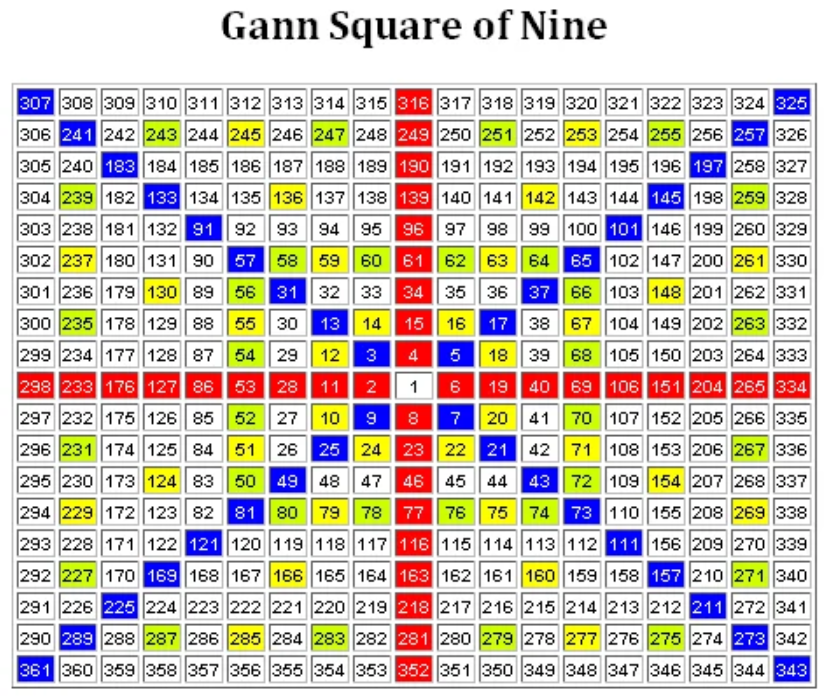
11.1 W.D. Gann’s market forecasting framework
W.D. Gann’s market forecasting framework incorporated proportional geometry and time symmetry concepts that many later analysts have linked to Fibonacci relationships and the golden ratio. Gann believed markets moved in structured cycles governed by natural law, where price and time were geometrically related. He used percentage retracements (such as 50%, 62.5%, and other harmonic divisions), square-of-nine calculations, and geometric angles to project future turning points. While Gann did not explicitly frame his work in modern Fibonacci terminology, many of his time-counting methods — including recurring cycle lengths and proportional expansions — align closely with Fibonacci intervals and golden-ratio-based projections used in contemporary technical analysis.
11.2 Time and Price Projections
In practice, traders influenced by both Gann and Fibonacci theory project time targets by measuring prior impulse waves and applying Fibonacci multiples (e.g., 0.618x, 1.0x, 1.618x) to estimate when the next major inflexion may occur. The underlying idea is that markets, as expressions of crowd psychology, unfold in proportional expansions and contractions across both price and time dimensions. Thus, Fibonacci ratios are not used merely for price retracements but also for estimating the duration of corrective phases, the length of trend extensions, and the timing of cyclical reversals. Whether interpreted through Gann geometry or Fibonacci wave symmetry within Elliott wave counts, the core principle is the same: markets may evolve according to repeating proportional relationships that link price movement and time progression within a unified structural framework.
11.3 The Gann Square and the Golden Spiral
The relationship between the Gann Square and the Golden Spiral lies not in direct geometric equivalence, but in their shared attempt to model proportional structure in time and price (or space) through mathematical scaling principles.
The Gann Square (often referring to the Square of 9 developed by W.D. Gann) is a numerical spiral arranged on a square grid. Values progress outward from a central origin in a rotating sequence, creating angular relationships—45°, 90°, 180°, etc.—that traders interpret as harmonics between price and time. Its logic is arithmetic and angular: it assumes markets unfold in cyclical, rotational structures where square roots and geometric angles define equilibrium points.
The Golden Spiral, by contrast, is logarithmic and multiplicative. It expands by a constant proportional ratio (φ ≈ 1.618), meaning growth is exponential rather than additive. It models natural expansion processes where structure remains self-similar as scale increases. In financial analysis, Fibonacci retracements and extensions—derived from the golden ratio—are used to anticipate proportional corrections and expansions.
The conceptual bridge between them is this:
- Both impose spiral geometry onto progression.
- Both assume cyclical recurrence embedded in growth.
- Both attempt to unify time and magnitude into a single geometric framework.
- Both treat movement as rotational rather than purely linear.
However, structurally they differ:
- Gann’s spiral is arithmetic and grid-based (square geometry).
- The golden spiral is logarithmic and continuous (curvilinear geometry).
If one were to integrate the two conceptually, the Gann Square can be viewed as a discrete, angular approximation of cyclical expansion, while the Golden Spiral represents continuous proportional growth. In other words, Gann focuses on angular harmonics in time–price space, whereas the golden spiral focuses on proportional scaling across time–space expansion.Their connection is philosophical and geometric rather than mathematically identical: both are attempts to express order, rhythm, and recurrence within dynamic systems.
12.0 Market implications of Quasiperiodic timing
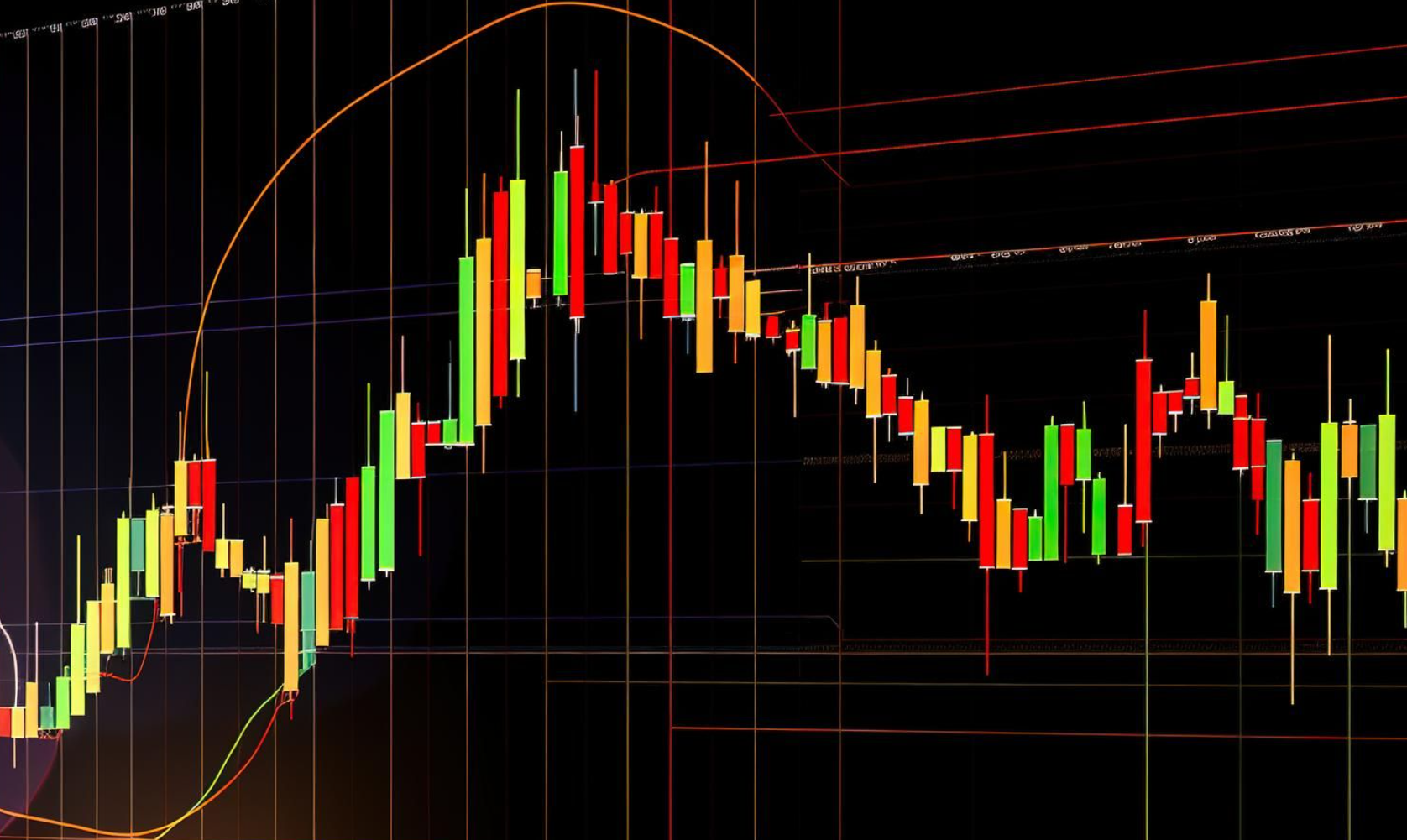
The concepts of quasiperiodic timing and time-quasicrystal behaviour offer a useful lens for understanding human behaviour and market dynamics, even though markets are social systems rather than physical ones. Human societies and financial markets rarely move in neat, repeating cycles; instead, they exhibit patterned behaviour punctuated by irregular shocks, regime changes, and sudden phase transitions. Quasiperiodicity captures this reality better than simple cyclical models: trends, bubbles, crashes, and behavioural waves recur with recognizable structure, but never in identical form or timing. This helps explain why purely mechanical or cycle-based forecasts so often fail.
In markets, quasiperiodic dynamics suggest that stability does not come from rigid repetition (fixed rules, strict cycles, or hard pegs) but from structured variability. Systems that allow flexible timing, diversified responses, and adaptive feedback tend to absorb shocks more effectively, while those locked into repetitive policy rhythms or leverage cycles become vulnerable to resonance—when many actors react in the same way at the same time, amplifying volatility. Just as quasiperiodic driving suppresses destructive resonances in quantum systems, diversity of strategies, staggered decision-making, and institutional asymmetry can dampen financial contagion.
At the behavioural level, humans are highly sensitive to narrative rhythms—elections, earnings seasons, crises, technological shifts—but these rhythms evolve rather than repeat. Collective psychology often shows “memory without repetition”: past crises shape expectations, but the response to each new event differs, producing emergent patterns rather than cycles. When belief systems, incentives, and information flows align too tightly, markets can enter unstable “phase transitions,” analogous to sudden decoherence in physics—crashes, panics, or manias.
The broader implication is that resilience in human systems comes from embracing ordered non-repetition rather than seeking perfect predictability. Policies, institutions, and market structures that are adaptive, modular, and temporally staggered are more robust than those designed around fixed schedules or assumed regular cycles. In this sense, quasiperiodic order provides a metaphor—and a warning—for governance and markets: stability is not the absence of change, but the ability to evolve without synchronising into self-destructive patterns.
13.0 Quasiperiodic timing and Geopolitical predictions
Applying the framework of quasiperiodic timing to geopolitics suggests that global events unfold not in neat, repeatable cycles, but in structured yet non-repeating patterns shaped by power transitions, economic stress, technological shifts, and collective psychology. Great-power rivalry, inflation shocks, energy crises, and conflict escalation recur throughout history, but each manifestation differs in scale, timing, and context. Like markets, geopolitical systems experience impulse phases — rapid expansions of influence or instability — followed by corrective consolidations, often culminating in regime shifts or structural resets.
Rather than expecting history to repeat mechanically, a quasiperiodic lens encourages observers to look for proportional relationships, stress accumulation points, and harmonic responses to systemic shocks. This perspective improves forward analysis by focusing on structural dynamics — debt cycles, hegemonic competition, demographic pressure, and technological disruption — while recognising that exact repetition is impossible. In this way, geopolitical forecasting becomes less about predicting identical historical echoes and more about identifying patterned, non-repeating waves of instability and transformation as they evolve toward future inflexion points.
14.0 Questions on Ralph Nelson Elliott and the Origin of Wave Theory
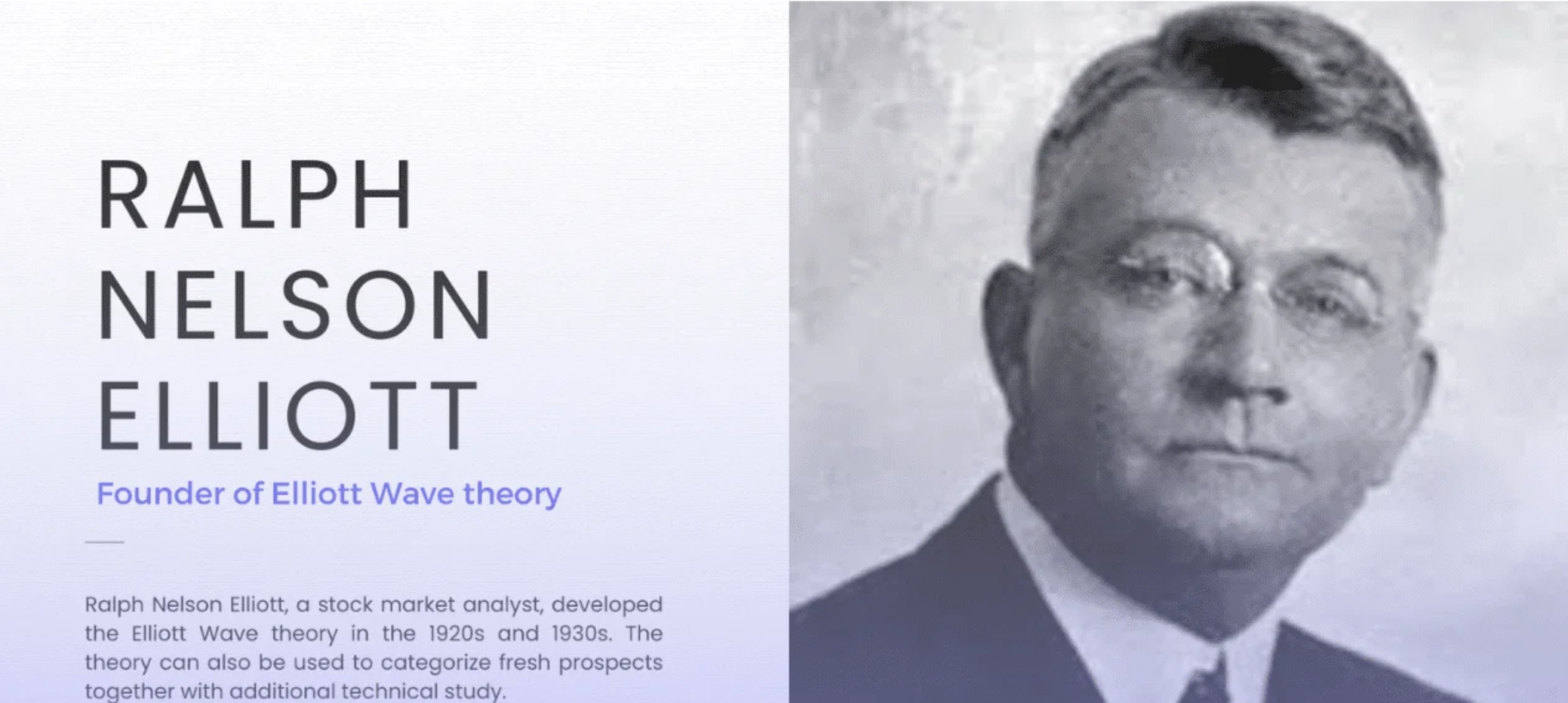
I have long theorised that Ralph Nelson Elliott did not so much invent the Elliott Wave Principle as rediscover it—revealing a complete structural model of human behaviour that predates modern finance and may reflect a far older, more advanced civilisational understanding of collective human dynamics. Elliott observed that markets unfold in recurring five-wave impulses and three-wave corrections governed by Fibonacci relationships, but the mathematical elegance, fractal scalability, and internal proportional consistency of the structure suggest something deeper than empirical pattern recognition.
Fully formed scientific models do not simply emerge from nowhere. Robust frameworks — especially those that endure for decades — typically arise through a combination of major conceptual breakthroughs and a sequence of smaller, iterative refinements that test, correct, and strengthen the original insight. Complex theories normally evolve: initial hypotheses are challenged, variables are adjusted, internal inconsistencies are resolved, and empirical feedback gradually sharpens the model. When a structure such as the Elliott Wave Principle appears largely complete at inception — with its fractal hierarchy, proportional symmetry, and internally consistent rules already articulated — it stands out. The absence of a long, visible chain of incremental development raises an important question: where did Elliott's original idea come from?
Strikingly, the theory appeared remarkably complete at its inception, without the gradual iterative refinement one would normally expect from a complex analytical framework developed through trial and error. Most robust theories evolve incrementally over decades as flaws are exposed and corrected; yet Elliott’s core structure has endured for nearly a century with its foundational architecture intact. That unusual completeness raises the possibility that he was not constructing a new model from scratch, but rather identifying and articulating an already existing structural law embedded in collective behaviour that originated from an older, undiscovered human civilisation, or perhaps from off planet, where these universal organising principles were well recognised?
Key Predictions
- Markets Will Continue to Exhibit Fractal Structure Across Scales
Financial markets will increasingly exhibit proportional wave structures across price and time, particularly during periods of inflation shocks, debt restructurings, and hegemonic competition. - Policy Systems Based on Rigid Cycles Will Prove Fragile
Governments and institutions locked into repetitive policy rhythms (fixed-rate cycles, synchronised fiscal responses) will be more vulnerable to systemic instability and resonance-driven crises. - Quantum-Inspired Stabilisation Models Will Influence Technology and the understanding of Human behaviour
Fibonacci-based quasiperiodic timing will inform the design of next-generation quantum computers, secure communications, and resilient network architectures. - Geopolitical Shifts Will Unfold in Structured but Non-Repeating Waves
Great-power competition, economic realignment, and technological disruption will follow proportional impulse–correction dynamics rather than exact and predictable historical repetition. aka Elliott's rule of alternation - Resilience Will Be Found in Ordered Non-Repetition
Systems that incorporate diversity, staggered timing, and adaptive proportional feedback—rather than rigid uniformity—will exhibit greater long-term stability in finance, governance, and technological infrastructure.

















 © David Murrin 2026. All images courtesy of Getty Images. |