Arkite Alerts Archive

Welcome to the archive of Arkite Alerts, Global Forecaster's free newsletter notifying subscribers of the latest news, podcasts, interviews, Global Trader performance reviews and more.

Arkite: the name derived from my Arkent Strategy to navigate, survive and thrive through the great shift.

Britain has been wilfully left exposed by Labour to the threat of Russian missile attacks.

Image
Britain

Introduction

Britain has been wilfully left exposed by Labour to the threat of Russian missile attacks.

Global Forecaster has been warning for five years that Britain is dangerously exposed to missile attack. Our Defend Britain campaign has highlighted how the UK—Putin’s number-one enemy in NATO—has left itself effectively defenceless and in urgent need of a national missile shield. As the prospect of war with Russia looms, the penny may finally be starting to drop.

1.0 The Wake Up Call

Britain is effectively undefended. That is the stark conclusion of a report published on Tuesday by MPs on the Parliamentary Defence Committee, laying bare the country’s acute vulnerability in the event of war. Despite Russia’s invasion of Ukraine—and repeated warnings that Britain could be next in the Kremlin’s sights—the report claims the UK “lacks a plan for defending the homeland.”

It is a direct rebuke to the irresponsible Labour government, which it accuses of moving at a “glacial” pace towards its pledge to raise defence spending to 3.5 per cent of GDP by 2035. If this sounds alarmist, that is precisely the point. As Professor Peter Roberts of the Royal United Services Institute (RUSI) argued,“ it is long past time to stop pretending that 'everything will be fine.”

“There has been no political will to be honest with the public and say, ‘We’re not going to stop missiles coming and hitting you. Some of you are going to die, hospitals will go under, and you may be without food, water, sewers and electricity,’ Prof Roberts told the committee earlier this year.

“We have not been brave enough to admit that what happens in Israel every day is a realistic scenario for London, Manchester, Edinburgh, or Inverness tomorrow. The enemy has both the capability and the intent—and is already considering it.”

Finally, the press might be waking up to the great betrayal, with articles like the recent Telegraph piece, 'The terrifying lack of missile defence leaves Britain open to attack ,' 

2.0 The Russian Threat

The missile threat to the UK has “proliferated enormously” since the end of the Cold War. Russia now possesses everything from hypersonic missiles travelling at Mach 15 to mass fleets of long-range drones and smaller arsenals of submarine-launched missiles lurking off Britain’s coast. On a first and second strike, Russia could and would hide missiles and drones inside a civilian container ship in the Channel and use them to cripple gas terminals or key infrastructure. As its conduct in Ukraine has shown, today’s Kremlin is not targeting military facilities alone—it is targeting the civilian infrastructure that would sap Britain’s will to fight. The Russians would aim to hit the electricity that supplies London… the banking sector and the natural gas port through which all our seven-day supply of gas arrives,” Roberts warned. “This is what the Kremlin is going after: the political will and freedom to act.”Britain’s hawkish stance on Ukraine—a stance that helped stiffen Europe’s spine—has made the UK a particular irritant to Moscow. On that basis alone, the GF estimate is A £40-50bn cost of rebuilding Britain’s missile and air defences, which is now a national imperative, as it was in 1936 when Germany built its massed air force. Crucially, Prof Roberts warns Britons not to assume that Russia would choose to intimidate European neighbours before targeting the UK.

3.0 No UK Missile Defences-Limited Drone Protection

Unlike Poland, Romania and other frontline NATO states, Britain has no modern surface-to-air missile defences. These systems give those nations a “hugely credible integrated air and missile defence capability.” By comparison, the UK has “next to nothing.” Nor does Britain possess an equivalent to Israel’s Iron Dome, designed to protect against short-range rockets and drones. As an island nation, the UK long assumed such threats were unlikely and consequently failed to prepare. As for air defences against slow-moving Russian drones that act as the backbone of the attacks against Ukraine, we only keep four alert fighters ready at any time!

4.0 Only Type 45s—and Too Few of Them, and they are Unreliable

Britain’s central missile defence relies on the Royal Navy’s Type 45 destroyers, equipped with the state-of-the-art Sea Viper system using Aster 30 missiles. Capable of hitting a cricket-ball-sized object travelling at Mach 3, Sea Viper can intercept drones and jets, but only minimal ballistic threats. During the 2012 Olympics, a Type 45 was stationed in the Thames Estuary to protect London. The problem: Britain has only six Type 45s. Initially, 12 were planned, but the post-9/11 belief that the primary threat came from terrorism—not Russia—led to the programme being cut in half. Worse still, only a fraction of the fleet is operational at any one time. As of August, just three Type 45s were seaworthy; in 2021, ministers admitted that only one was fully functional—a situation MPs branded “operationally unacceptable.”

5.0 The Wargame: Britain Has No Clothes

These weaknesses were laid bare in The Wargame, a recent Sky News simulation that tasked real former ministers—including Sir Ben Wallace and Jack Straw—with responding to a Russian attack. Participants were horrified to discover that, with only one Type 45 at sea, they would have to choose between defending Whitehall or critical military assets. “We would have a Hobson’s choice: protect London or other cities, or protect a naval taskforce,” observed Gerry Northwood, a former Royal Navy captain. “We’d have very difficult choices, with very few assets to distribute.”

6.0 Russian Missiles From the Sea

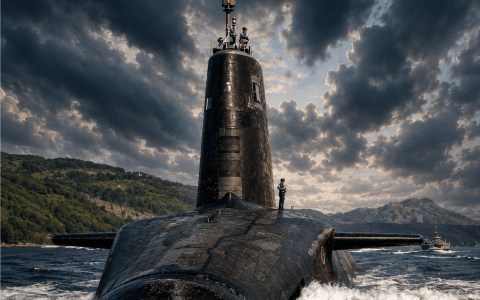
Any Russian missiles launched from Russian territory would cross NATO airspace first, potentially being intercepted by European allies. The greater threat to the UK  would come from rockets launched by strategic bombers or submarines closer to British shores from the north and west. After an initial strike, Russia would lose the element of surprise and risk its bombers or submarines being hunted by NATO forces. For that reason, analysts believe Moscow might focus on very high-value military targets rather than civilian infrastructure—at least initially. Russia would almost certainly also use its new Oreshnik intermediate-range missiles, deployed last year against the Ukrainian city of Dnipro. For now, supplies are limited—but increased production could make them a significant threat.

7.0 No Conventional Strike Capability-Britain is Toothless

To make matters worse, Britain has no converntional retaliatory capability to strike back, as we do not have any long-range missiles and our F-35s are not equipped with stand-off missiles, which means that Putin could attack with impunity unless the Americans joined in.

8.0 What Britain Desperately Needs-Yesterday

The British people need to understand that, first, the Conservatives, and now Labour under Starmer, have wilfully left Britain undefended because they have refused to face the reality that we are already in a state of conflict with Russia. If Britain can wake up and regain its national resolve, it will urgently need the following:

As part of this summer’s Strategic Defence Review, the Government plans to acquire a few rather than the many needed of

  • Additional Sky Sabre air-defence launchers – mobile, point-defence systems to protect key sites from aircraft and drones
  • More Wedgetail early-warning aircraft – improving detection of incoming threats

Immediate upgrades are needed to the limited RN capabilities in service.

  • Keep the Type 23s with Sea Ceptor missiles in service, and those that are in mothballs.
  • Equip the UK carriers with Aster missiles for self and area defence.

But Britain needs far more, as we need an Iron Dome

  • Many more alert Fighters (Typhoons and F-35s) should be ready to launch and intercept the first Russian missile strike.
  • At least 12 SAMP/T area-defence missile batteries firing the new Aster 30 B1NT, which should be installed in the Type 45s to replace the Block 1s. Then, as soon as possible, the 30 Block 2 BMD should be bought and put into service.
  • Four US THAAD (Terminal High Altitude Area Defence) batteries to counter Oreshnik intermediate-range missiles.
  • Build the Type 83 Air Defence Destroyer fleet along with its arsenal ships as a national imperative

Both long-range systems could be integrated into the European Sky Shield Initiative, effectively covering its northern and western flanks.

  • Strengthen naval defences to keep Russian submarines north of the Iceland-Faroes gap

The cost for Britain to build an emergency air-defence system would be substantial—around £40–50 billion, and not as a one-off expense. As Prof Roberts notes, adversaries continually develop missiles that are faster, stealthier and more manoeuvrable. Defence must evolve continuously.

But imagine if Chamberlain had decided not to invest in the world’s first integrated air-defence system in 1937. The Battle of Britain would not have been our finest hour—it would have been a wipe-out. So the people of Britain and their leaders must decide: do they want a wipeout or a fighting chance of survival?

9.0 What Can You Do?

Subscribe to Global Forecaster, get educated and write to your MPs to demand that they act to defend Britain with an emergency defence program

If YOU want peace, then Stand Tall and Go Gold, so you can become informed and have a say in our future.

SUBSCRIBE TO - Murrinations Gold


Learning More About Global Forecaster 5

Image
GF2

For those of you who are relatively new to Global Forecaster, I thought it would be interesting to give you a brief overview and perspective of my work over the past two decades and some current views. Curious about the power of AI, I generated these answers using ChatGPT!
 

Question 7 - What are David Murrin's views on markets?

David Murrin holds a bearish view of the US dollar's future. He believes that the dollar's global dominance is in decline, largely due to the shifting balance of global power and the rise of competing currencies, particularly the Chinese yuan. Murrin argues that the US is facing structural economic issues, including rising debt and inflation, which undermine the dollar's stability as the world’s reserve currency. He anticipates a broader de-dollarisation trend as nations seek alternatives in response to US fiscal policies and geopolitical moves. Murrin also points out that global inflation and geopolitical instability, such as conflicts involving China and Russia, will further erode confidence in the dollar. He forecasts that, as the US empire declines, the dollar will lose its reserve status, paving the way for a more multipolar currency system where other national currencies, especially in Asia, play a larger role in global trade and finance (https://www.davidmurrin.co.uk/) (https://palisadesradio.ca/david-murrin-we-are-looking-at-a-decade-of-conflict/) (https://www.davidmurrin.co.uk/media).

David Murrin has been highly bullish on gold, viewing it as a critical asset in times of geopolitical instability and economic uncertainty. He believes that as the US dollar weakens and the global financial system faces increasing strain, gold will emerge as a primary store of value. Murrin emphasises that gold performs well in inflationary environments and during periods of declining confidence in fiat currencies, especially when global power dynamics are shifting. Murrin has consistently predicted that gold will rise sharply as geopolitical conflicts escalate and central banks continue to print money, contributing to global inflation. He also notes that as nations like China and Russia seek to challenge US financial dominance, gold will become an essential reserve asset for countries looking to diversify away from the dollar (https://www.davidmurrin.co.uk/) (https://palisadesradio.ca/david-murrin-we-are-looking-at-a-decade-of-conflict/).


Question 8 - What are David Murrin's views on Ukraine?

David Murrin holds a critical view of the conflict in Ukraine, seeing it as a manifestation of broader geopolitical shifts, particularly between the West and rising authoritarian powers like Russia and China. Murrin interprets the Ukraine conflict as part of an inevitable clash driven by the decline of Western power, with the war serving as a precursor to larger global realignments. He emphasises that the West, including the US under President Biden, has been too reactive rather than strategic in its approach. Regarding Biden’s role, Murrin believes that Biden's leadership has been indecisive and overly cautious, particularly in the early stages of the conflict. He argues that, while Biden and to some degree Trump has supported Ukraine, the reluctance to supply certain advanced weapons or allow deeper strikes within Russian territory reflects a fear of provoking Russia, which, in Murrin’s view, limits the West's ability to decisively influence the war's outcome.

Murrin sees this hesitancy as symptomatic of the broader decline in Western leadership, where short-term caution prevails over long-term strategic action (https://podcasts.apple.com/au/podcast/the-state-of-it/id1573113137) (https://www.aol.com/uks-starmer-biden-discuss-ukraines-193356052.html). Overall, Murrin suggests that Trump's handling of Ukraine is part of a larger pattern of the West failing to effectively counter the rise of authoritarian regimes. He has repeatedly pointed out that without bold action, this will only embolden powers like Russia and China.


If you wish to understand our ever-more entropic world, subscribe to Murrinations Gold for the price of a newspaper and see the world without those rose-tinted glasses so you can navigate the rapids ahead.

Image
glasses
Image
upgrade murrination of the week banner


The Red Tsunami

Text to go here...

Image
book

Geopolitics Panel Discussion | GPFO European Conference 2025

Dear Arkite,

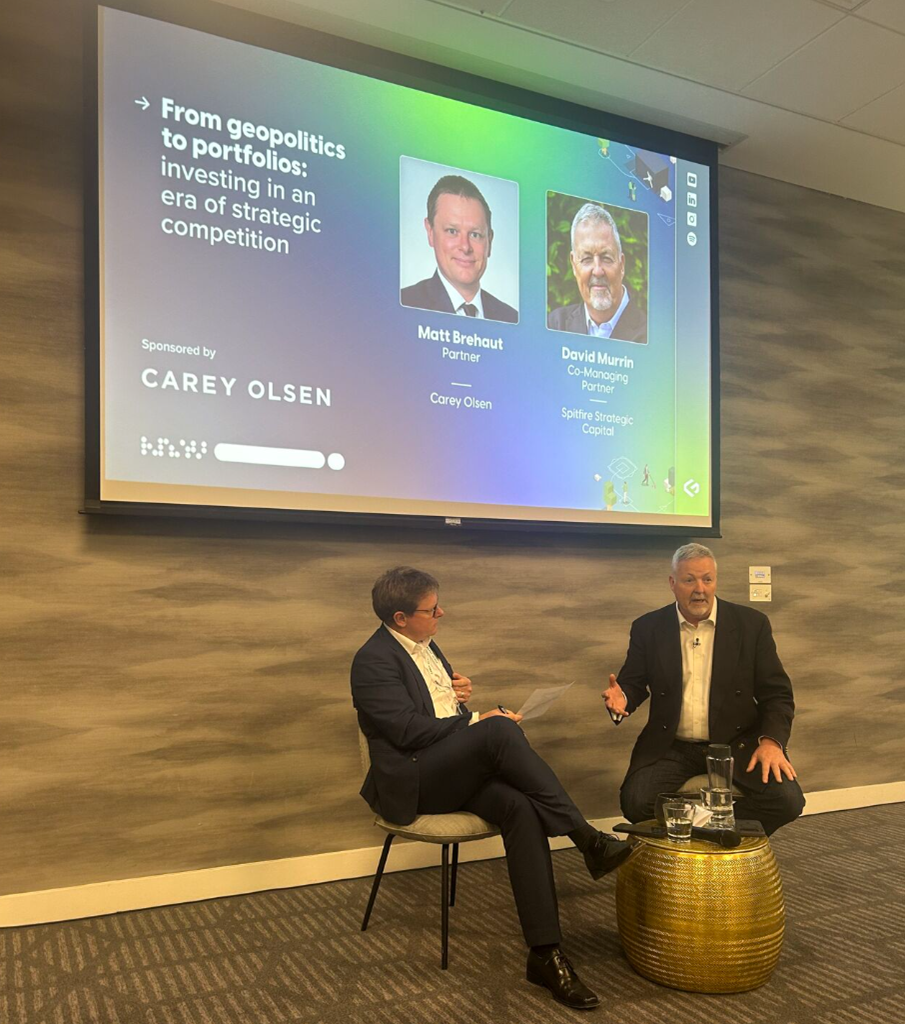
Watch the recent GPFO Geopolitics Panel Discussion, which included myself and several eminent speakers. The annual GPFO conference brings together family offices across the globe to consider, debate and reflect on the key issues of the year past and the year ahead.

Image
GPFO panel discussion

The discussion explored how geopolitical shocks, ranging from tariff skirmishes to kinetic conflicts, are redrawing trade routes, currencies, and energy flows. Macro strategists shared scenario maps and allocation pivots to help family offices navigate volatility and safeguard multi-generational wealth. 

It was noted as the most popular panel discussion of the day. 

Watch Now

The danger of gray-zone warfare

Image
RED WAVE

In a quote from the Red Tsunami

“The danger of grey-zone warfare, especially its cultural dimension, is that it deliberately corrodes a society’s immune response, delaying collective Nations' reaction times by normalising incremental assaults. Victims become acclimatised to subtle attacks and fail to recognise or respond to the next phase of escalation. In effect, the target is cooked slowly, like a frog in warming water. That, to my mind, describes what the ‘axis of autocracy’ (China and its allies Russia, North Korea, and Iran) has been doing to America, Europe, and Israel—and now the water is finally beginning to boil and we are still in the cooking pot!”

David Murrin

When War Blindness Becomes Cowardice

Image
war blindness

A few days ago, I spent a very engaging hour on a panel discussing geopolitics and defence. During that time, I had a lively exchange with one of the panellists,  a well-known former Financial Times journalist. The discussion quickly revealed what I would describe as “war blindness”  a mindset incapable of grasping that we are already in the midst of an escalating global conflict that history will recount as World War III. Because the Middle East is in a Regional War in a temporary hiatus and we are fighting Russia directly in Ukraine and across Europe. While living under the constant strategic shadow of China’s threat over Taiwan and the Western Pacific.

The mechanisms of this war blindness became painfully clear. Despite the individual’s intelligence, their reasoning resembled that of someone with little understanding of history or strategy. Assertions such as “Putin only wants eastern Ukraine,” or “America would never defend Taiwan,” and “China is a peaceful country that has never gone to war,” demonstrated a profound detachment from reality. In truth, China has waged numerous wars throughout its modern history, including with nearly all its neighbours until 1975. The claim that “people won’t fight for their country” struck me as projection, not realism, but cowardice disguised as rationality.

The notion that no one would fight because they themselves would not is profoundly wrong. Members of our brave armed forces volunteer to risk their lives to defend our nation and sustain our civilisation. Yet it is precisely this attitude of fear and denial that has left us unwilling to invest properly in our nation's defence with the emergency spending now required, denying these brave men and women the tools they need to protect us and themselves in combat. Such sentiments reflect cowardice and defeatism, yet still many of our young people are ready to stand and fight for what they believe in.

To stave off defeatism, we must give our armed services our full financial and moral support. This means that fully funding the military should be Britain's number one priority, so that our service men and women can fight our enemies with confidence. Ensuring our forces have the best equipment, whilst we, the general population, prepare ourselves, mentally and materially, to defend what we value, rather than hiding behind the comforting illusion of “war blindness.”

The Betrayal of The Troubles Bill

But it also means defending our servicemen against lawfare. Because the Labour government currently has a mindset that is undermining our services at every level. A prime example is that it is pursuing legislation known as the Troubles Bill, which will expose our ex-servicemen and women, particularly those who served in Northern Ireland, to lifelong legal jeopardy. This stands in stark contrast to the forgiveness extended to former terrorists. How can it be that those who fought for what was right are still hounded, while those who murdered are free? This is the ultimate betrayal of our society,  to persecute those who defended us.

How can we expect our brave servicemen to risk their lives in our defence if we, as a nation, fail to have their backs?

This was Posted on a military chat from Animal Farm.

Image
ANIMAL FARM

“Boxer, the cart-horse, embodies the honest, tireless labourer who believes that loyalty and hard work will be rewarded. His mottos, “I will work harder” and “Napoleon is always right,” show his faith in the collective cause and in leadership. Yet this very trust seals his doom. As his body begins to fail from years of overwork, the pigs reassure him with promises of retirement, grass paddocks, and care.

The betrayal becomes stark in his final moments. When Boxer collapses from exhaustion, a van arrives to take him away. His comrades rush to see him off — only to realise in horror that the side of the cart reads it belongs to the knacker, the horse-slaughterer. Boxer, too weak to break free, tries to kick his way out, but his strength is gone. The pigs cover up the truth, telling the animals the van once belonged to the knacker but had been purchased by a veterinary surgeon. Most of the animals, too trusting, believe the lie.

Boxer’s death crystallises the tragedy of misplaced faith and exploited devotion: he gave everything to Animal Farm, yet in the end, he was discarded when no longer useful. His story is a warning about the dangers of blind obedience and the cruelty of corrupt leadership.

As Orwell writes in his final moments:

But the van was already gathering speed, and Boxer’s face disappeared from the window. There was the sound of a tremendous drumming of hoofs inside the van. He was trying to kick his way out. The time had been when a few kicks from Boxer’s hoofs would have smashed the van to matchwood. But alas! his strength had left him, and in a few moments the sound of drumming hoofs grew fainter and died away. The animals stood gazing after it, their eyes filled with tears.

And who is Boxer today??”

Remembrance Is Not Enough, but Should Be A Call to Courage


Image
R day

Today in Britain is Remembrance Sunday, just two days before Armistice Day, which is marked by the eleventh hour of the eleventh day of the eleventh month, when the guns of the First World War fell silent. It is a day when we honour the courage of those who fell in all the wars fought to protect the continuity of our British nation, its people, and its values. It is right that we keep the two-minute silence to remember their sacrifice. For the majority of British families, Remembrance Day is not just a date in the national calendar — it is woven into family history, marked by stories of loss and courage that span generations. My own family, like so many others, fought and suffered in both world wars.

1.0 A very personal Remembrance Day

My grandfather, Major Horace James Martin, served in the First World War with the Indian Army, fighting in the Mesopotamian campaign. He returned home deeply affected by the horrors he had witnessed — what we would now recognise as PTSD — and, tragically, he took his own life during the Second World War when his eldest son, Barry Martin, my uncle, joined the Royal Air Force. Where he served as a tail gunner in Bomber Command, completing an extraordinary 80 operations over Germany — a survival feat almost unheard of among aircrews of the time.

Then there was my indomitable and quintessentially English Aunty Irene, who served in the Women’s Auxiliary Air Force (WAAF) as a fighter controller during the Battle of Britain. She would tell me vivid, haunting stories of the young fighter pilots they knew — men they would drink with in village pubs one evening, only to hear their screams over the radio the next day as their Spitfires and Hurricanes burned and spiralled to the ground.

This year, as I sought to deepen my understanding of our family tree, I discovered the story of my great-grandfather, Ernest Nobbs (c.1886 – 24 March 1918). Born in Sprowston, near Norwich, Norfolk, he later moved to Gosport, where he joined the Royal Marine Reserves. In 1915, he formed up with the Hood Brigade of the Churchill-inspired and newly formed Royal Naval Division. He then fought through some of the fiercest campaigns of the Great War — Gallipoli, the Somme, the Battle of Arras, and Passchendaele (Third Ypres, 1917).

On 24 March 1918, during the German Spring Offensive — known as the Kaiserschlacht — Second Lieutenant Ernest Nobbs was shot in the head and killed in action near Bertincourt, just south of Lebucquière in northern France. The offensive marked Germany’s final desperate attempt to break the Allied lines before American reinforcements arrived. The fighting was ferocious — marked by rapid advances, relentless shelling, and catastrophic losses on both sides. My great-grandfather’s death came during one of the most chaotic and tragic phases of the war. His sacrifice was part of a generation’s collective struggle — ordinary men caught in extraordinary circumstances. Tragically, his wife, Elizabeth M. Howe, died just a year later, a young widow left bereaved by the war that claimed so many families across Britain.


2.0 We Are failing our Forebears.

However, remembrance alone is not enough. This moment demands more of us as it requires deep reflection from us all. What would our forebears think of the gift of freedom they gave us? Have we lived up to their expectations? What would they make of the nation whose streets we walk today, the country for which they gave their lives? I fear that, as  Alec Penstone, who played a vital role sweeping for mines during the D-Day landings, said recently the Britain, his comrades died to defend, is a shadow of its former self.

“What we fought for was our freedom, but now it’s a darn sight worse than when I fought for it,” he told Good Morning Britain. “I’m sorry, but the sacrifice wasn’t worth the result of what it is now.”


3.0 Remembrance alone is not enough. We need Courage

I fear that the majority of our fallen would echo Alec's sentiment if they had a voice in death. Because they, too, would be disappointed in their grandchildren. While societies evolve, cultures change—and values with them. In 1914 and in 1939, the British Empire still ruled much of the world; today, it can't even control the English Channel against daily invasion.

Yet some fundamentals endure, and our forebears have every right to expect them to survive in us. Foremost is courage—the same courage they showed when they went to war to defend the nation; the same courage that took Britain to war against Germany, not because we were attacked, but on the principle of protecting Poland. In that spirit, our support for Ukraine from the moment it was invaded is something that would make them proud. However, what would make our fallen turn in their graves is our nation's collective and individual lack of resolve in facing our enemies today, in the form of Russia and China, who are clearly seeking to destroy our country. Warblindness is a prevalent disease today that borders on cowardice to stand up and face the darkness that we now face.

To live up to the sacrifices of our fallen forebearers, we must find the courage to uphold and preserve our core values—values that have been eroded by woke liberal attitudes that have allowed our social cohesion to be diluted from within, including through immigration without integration. The belief, held by some, that we will not need to fight to defend our nation—or that we would be unable to do so—is a shameful, cowardly perspective that would make our forebears turn in their graves.

So Remembrance Day is not just about remembering, it is a call to courage—to live up to their example.

Never more than today must we do so, to ensure the preservation of our nation.

Markets, Hegemonic War Cycles and the Threat of World War 3

Dear Arkite,

Listen now to my latest interview on the IRF podcast:

Image
IRF podcast

David Osman of IRF is joined by David Murrin, the Founder of Global Forecaster.

In this podcast David Murrin discusses his '5 Stages of Empire' model and the influence of longer run cyclical trends on geopolitical risks, political factors, the world economic outlook and the prospects for the global financial markets. David assesses the deep-seated problems in the USA and the damage that President Trump’s tariffs and other policies are doing to the country’s international reputation. He points out that this has major implications for the value of the US dollar and its role as the world’s reserve currency.

David also explains the basis for his dramatic views about the dangers of Chinese expansionism in northeast Asia and the rising risks of a wider war in the Middle East, as well as the potential for an escalation of Russia’s hostile actions in Europe. David says this has put us on the cusp of World War 3, pitting the West against hostile actions by the “Axis of Autocracy”.

Meanwhile, he points out that the unfolding of a commodity super cycle will have a profound impact on global inflation, bond markets and cryptocurrencies.

David notes that this helps to explain the recent sharp increase in the price of gold into overbought territory. In these circumstances, David sees the prospects for world stock markets becoming increasingly problematic, particularly the outlook for the US stock market and its dominant AI investment theme.

Listen Now

Global Forecaster's Aspirations For Peace Through Genuine Strength


Image
sub

Our Aspirations for Ukraine and The Prevention of WW3

America and Europe must confront Putin as a bully, acting as one, responding swiftly and with Iron determination to all provocations, and ensuring that words are matched by decisive and punitive actions.

Europe and America must move to an emergency war footing, delivering maximum aid to Ukraine to ensure victory and the ejection of Russian forces to the 2014 borders. At the same time, NATO should establish a “Sky Shield” an integrated air and missile defence system, extending initially to the Dnipro River, with a clear warning to Putin that any further Russian incursion across NATO borders or grey zone actions would trigger a progressive shift of the defensive line 100 miles westward foir each mistomina, until the skyshiled reached over Ukraine’s pre-2014 borders. Focusing Russian ground forces to retreat.

A swift Ukrainian victory would demonstrate renewed Western resolve, which could buy critical time. It would delay X's plans for war in the Pacific while the West closes its capability gap and restores credible deterrence in Asia. The desired outcome is the emergence of a new Cold War that remains contained, preventing escalation into World War III.

Global Forecaster’s aspirations represent the culmination of our analysis and predictions. The first step to joining us and echoing our aspirations is enhancing your understanding of Putin's war strategy and weapons.

This week, we are publishing three extended reports on Russia that will give our readers a unique insight into Putin's mindset, strengths, weaknesses, and the prognosis for Russia and the war in Ukraine and across Europe.

If YOU want peace, then Stand Tall and Go Gold, so you can become informed and have a say in our future.

SUBSCRIBE TO - Murrinations Gold

Podcast: Rulers of the Waves: The Past, Present, and Future of Global Navies

Dear Arkite,

Listen now to my latest The State Of It podcast: Rulers of the Waves: The Past, Present, and Future of Global Navies

Image
The State of It

Horatio and David discuss the past, present and possible future of maritime power. David talks about how and why the Britain rose to dominate the waves in the 18th and 19th centuries, the pivotal lessons from that naval strategy, and the subsequent decline of Western naval supremacy.

Horatio also takes the conversation onto the present and future. Discussing the critical maritime power shift, driven by China’s shipbuilding capabilities. Pivoting also towards modern technologies such as quantum tech and drones and how they might impact navies and modern warfare. Thus pressing the west to overcome the sea blindness that we are currently experiencing before it gets too late to regain a foot in global sea power.

Listen Now