


A few days ago, I spent a very engaging hour on a panel discussing geopolitics and defence. During that time, I had a lively exchange with one of the panellists, a well-known former Financial Times journalist. The discussion quickly revealed what I would describe as “war blindness” a mindset incapable of grasping that we are already in the midst of an escalating global conflict that history will recount as World War III. Because the Middle East is in a Regional War in a temporary hiatus and we are fighting Russia directly in Ukraine and across Europe. While living under the constant strategic shadow of China’s threat over Taiwan and the Western Pacific.
The mechanisms of this war blindness became painfully clear. Despite the individual’s intelligence, their reasoning resembled that of someone with little understanding of history or strategy. Assertions such as “Putin only wants eastern Ukraine,” or “America would never defend Taiwan,” and “China is a peaceful country that has never gone to war,” demonstrated a profound detachment from reality. In truth, China has waged numerous wars throughout its modern history, including with nearly all its neighbours until 1975. The claim that “people won’t fight for their country” struck me as projection, not realism, but cowardice disguised as rationality.
The notion that no one would fight because they themselves would not is profoundly wrong. Members of our brave armed forces volunteer to risk their lives to defend our nation and sustain our civilisation. Yet it is precisely this attitude of fear and denial that has left us unwilling to invest properly in our nation's defence with the emergency spending now required, denying these brave men and women the tools they need to protect us and themselves in combat. Such sentiments reflect cowardice and defeatism, yet still many of our young people are ready to stand and fight for what they believe in.
To stave off defeatism, we must give our armed services our full financial and moral support. This means that fully funding the military should be Britain's number one priority, so that our service men and women can fight our enemies with confidence. Ensuring our forces have the best equipment, whilst we, the general population, prepare ourselves, mentally and materially, to defend what we value, rather than hiding behind the comforting illusion of “war blindness.”
The Betrayal of The Troubles Bill
But it also means defending our servicemen against lawfare. Because the Labour government currently has a mindset that is undermining our services at every level. A prime example is that it is pursuing legislation known as the Troubles Bill, which will expose our ex-servicemen and women, particularly those who served in Northern Ireland, to lifelong legal jeopardy. This stands in stark contrast to the forgiveness extended to former terrorists. How can it be that those who fought for what was right are still hounded, while those who murdered are free? This is the ultimate betrayal of our society, to persecute those who defended us.
How can we expect our brave servicemen to risk their lives in our defence if we, as a nation, fail to have their backs?
This was Posted on a military chat from Animal Farm.
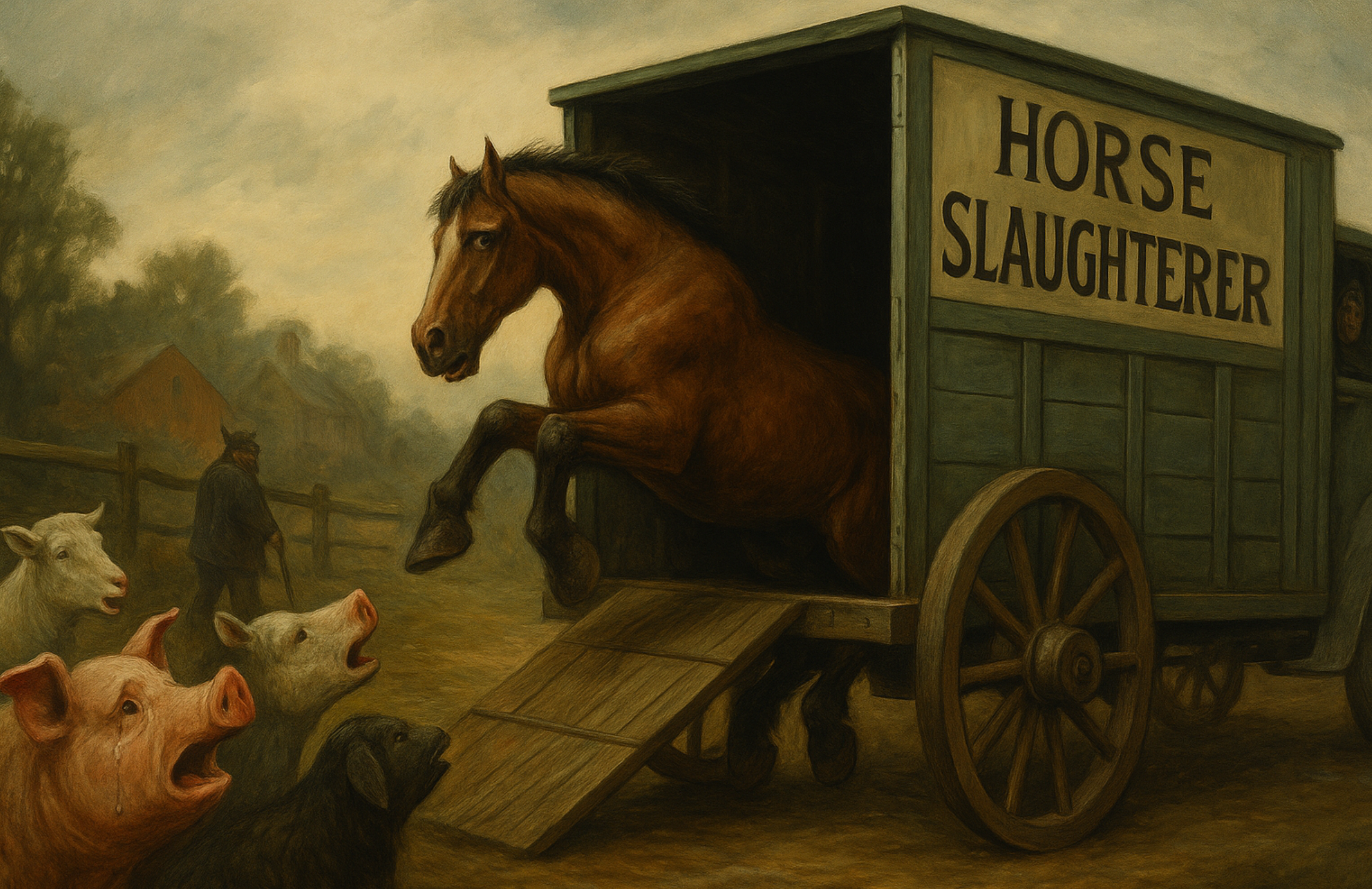
“Boxer, the cart-horse, embodies the honest, tireless labourer who believes that loyalty and hard work will be rewarded. His mottos, “I will work harder” and “Napoleon is always right,” show his faith in the collective cause and in leadership. Yet this very trust seals his doom. As his body begins to fail from years of overwork, the pigs reassure him with promises of retirement, grass paddocks, and care.
The betrayal becomes stark in his final moments. When Boxer collapses from exhaustion, a van arrives to take him away. His comrades rush to see him off — only to realise in horror that the side of the cart reads it belongs to the knacker, the horse-slaughterer. Boxer, too weak to break free, tries to kick his way out, but his strength is gone. The pigs cover up the truth, telling the animals the van once belonged to the knacker but had been purchased by a veterinary surgeon. Most of the animals, too trusting, believe the lie.
Boxer’s death crystallises the tragedy of misplaced faith and exploited devotion: he gave everything to Animal Farm, yet in the end, he was discarded when no longer useful. His story is a warning about the dangers of blind obedience and the cruelty of corrupt leadership.
As Orwell writes in his final moments:
But the van was already gathering speed, and Boxer’s face disappeared from the window. There was the sound of a tremendous drumming of hoofs inside the van. He was trying to kick his way out. The time had been when a few kicks from Boxer’s hoofs would have smashed the van to matchwood. But alas! his strength had left him, and in a few moments the sound of drumming hoofs grew fainter and died away. The animals stood gazing after it, their eyes filled with tears.
And who is Boxer today??”















 © David Murrin 2026. All images courtesy of Getty Images. |